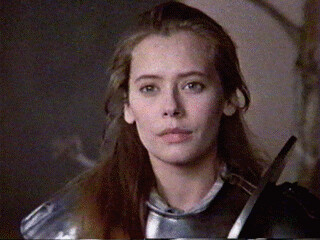
Bradamante

bradamante hearts and armour
Barbara di Rossi as Bradamante

Bradamante (bra-da-MAHN-teh) is one of the greatest female knights ever portrayed in English literature. She is one of the first examples of the reverse damsel-in-distress - saving her husband instead. She can be found in Charlemagne legends Orlando Innamorato by Matteo Boiardo, Orlando Furioso by Ludovico Ariosto, The Nonexistant Knight (Il Cavaliere Inesistente) by Italo Calvino, and Handel's Alcina. Later on, Andrew Lang wrote about her in The Red Romance Book. Robert Garnier also wrote a tragicomedy with her name as the title. She is equivalent to Britomart from The Faerie Queene. Lastly, Barbara di Rossi depicted Bradamante in the 1983 film "Hearts and Armour."

Bradamante means "wild love/loving wildly" in Italian, from the words brado and amante. She is also sometimes spelled Bradamate or Bradamant. Her lover Roger is Ruggiero, or Ruggero in Italian. He is also sometimes spelled Rogero. She is a valiant, white-armored Christian knight (of France) with a magical weapon, who is in love with a Saracen knight. Her nickname (alias?) was "the Maid," a nod to Joan of Arc.

Bradamante is said to be the ancestor of the d'Este (or just Este, the House of Este) family, 17th century Italian cello patrons.

Comments

Popular posts from this blog

Massimo

Today's name: Massimo (male) Pronunciation: MAH-see-moh Potential nicknames: Masi, Simo, Max Origin: Along with Massimiliano, Massimo is the Italian variant of the Latin name Maximilian (which was the name of three Roman emperors and a few saints), meaning "greatest." Popularity: Massimo did not rank on the top 1000 baby names in 2010, but there were 148 baby boys born named Massimo and 5 named Massimiliano. In 2011 there were 107 named Massimo. Fun fact: (1) The name Maksim is also a variant of Maximilian. (2) Massimo has been the surname of many powerful Roman families. (3) Saint Massimo, a 5th century bishop. (4) Massimo D'Alema, Italian Prime Minister. (5) Massimo Capra, Canadian celebrity chef. .

Galician Baby Names

I grew up on a street that was named an Italian variant of Roger. When I got married and we bought our first house, it turned out to be on Roger Street. Once noting that coincidence, I started searching for other variants of the name. However, female variants turned out to be pretty nonexistent. Save for Roxeria, which I later discovered was the Galician female form, possibly pronounced rohz-AIR-ee-uh. That led me to a few lists of female Galician names, ranging from common to rare. Here is a sampling of names not often heard here in the states... Albina Alda Alma Alodia Aloia Amada Amadora Amalia Amparo Anisia Antia Araceli Aranzazu Artemisa Avelina Azucena Baia Balbina Baltasara Beatriz Benvida Berenice Bieita Branca Braulia Caetana Carola Casilda Casimira Ceferina Celsa Cipriana Cira Clorinda Coralia Cornelia Cosima Davinia Delfina Desideria Dionisia Dominga Dorinda Dorotea Dositea Edelmira Edenia Elba Elvira Emiliana Etelvina ...

Elowen

Elowen is a recent Cornish baby name meaning "elm." It may not take off in America like the last Cornish hit, Jennifer, but it's certainly pretty. She's part of a "linguistic revival," as Appellation Mountain puts it  here . Her nickname could be Ellie, Elle or Ella, or a more unusual choice, Wendy. The pronunciation of Elowen is "ell-LOH-en," though most Americans will probably stick with "ELL-oh-wen." Please note that it is not spelled Elowyn. There is a similar name, Eowyn, but if you spell it Elowyn it will no longer be the Cornish name meaning elm tree, just some creative name. Other great Cornish names include Penrose, Chesten (the Cornish form of Christine), Demelza, Denzel, Hammitt, Kerensa/Kerenza, Meraud (very similar to French gem name Emeraude, both meaning emerald, but Meraud is pronounced "meh-row"), Merryn, Morwenna, Tremain, Emblyn, Jory, Massen, Treeve and Cotton. Here's 's a link to a post on Cornish n...